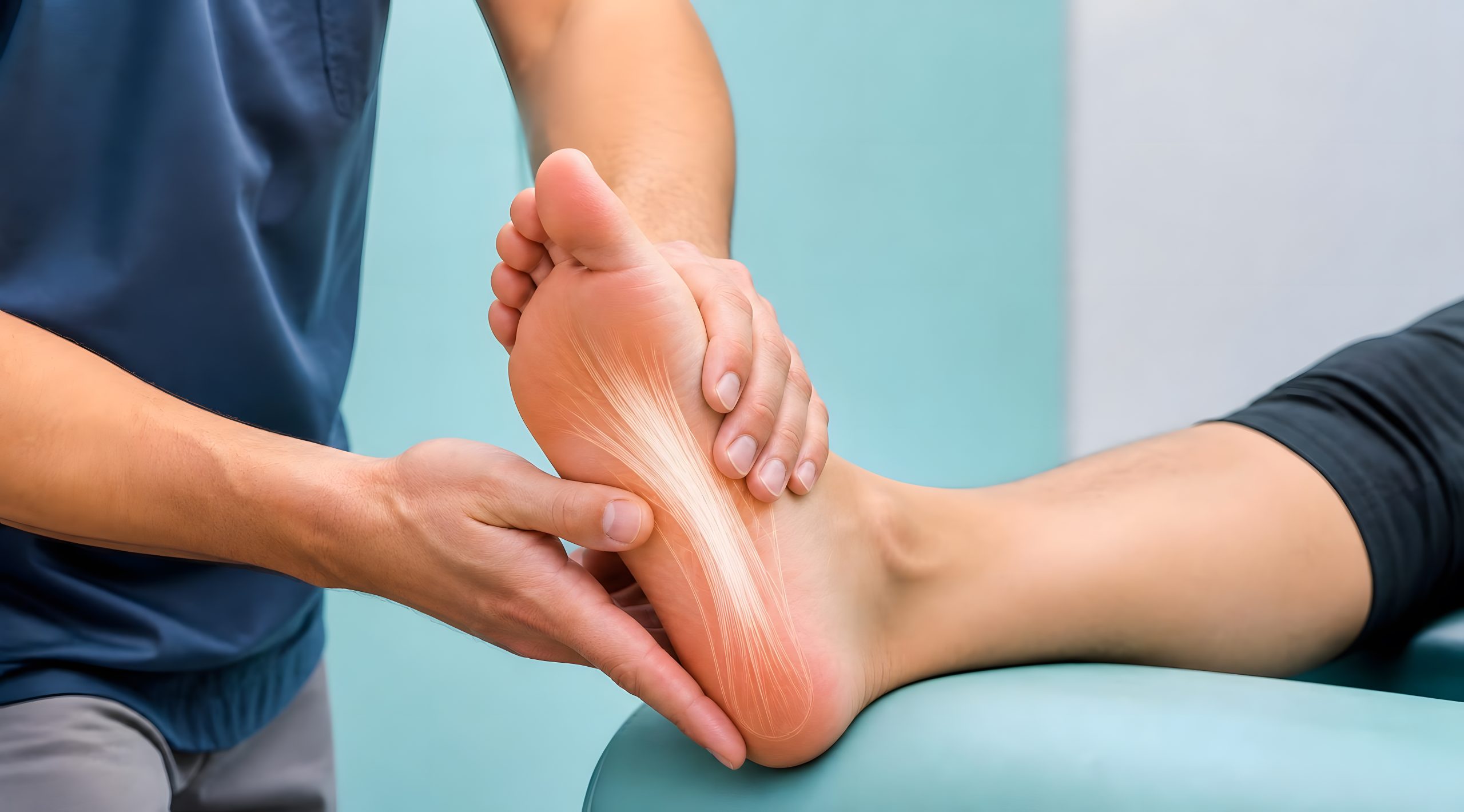
Plantar Fasciitis Treatment: What Really Works for Heel Pain?
Plantar fasciitis is one of the most common issues I see in the clinic. It causes of that seering heel pain when you first get out of bed, or get up from sitting after a long period. But just because its common does not mean every case should be treated the same way.
Some people improve with a few simple changes in footwear and activity. Others struggle with heel pain for months or even years despite stretching, inserts, injections, rest or repeated attempts to “wait it out.”
The key is identifying why the plantar fascia is being overloaded and why its not healing. The next step is creating a treatment plan based on the individual—not simply treating the painful spot.
Taking a personalized approach to plantar fasciitis treatment includes physical therapy, targeted exercise, manual treatment, footwear, taping or activity modification and SoftWave Therapy, a form of extracorporeal shockwave therapy. Most people do some of these things over time vs having a comprehensive program to address it all at once.
What Is Plantar Fasciitis?
The plantar fascia is a strong band of connective tissue that runs along the bottom of the foot from the heel toward the toes. It helps support the arch and assists with transferring force when you walk, run and push off the ground.
Plantar fasciitis—often also called plantar fasciopathy—occurs when this tissue becomes painful and irritated.
People commonly describe:
- Sharp or stabbing heel pain
- Pain with the first few steps in the morning
- Heel pain after sitting for a long time
- Pain after prolonged walking or standing
- Pain that improves after “warming up” but returns later
- Tenderness near the inside portion of the heel
- Difficulty running, exercising or walking barefoot
Although the word “fasciitis” suggests inflammation, chronic plantar heel pain is often more complicated than inflammation alone. Changes in tissue loading, strength, mobility and tissue capacity can all contribute.
What Causes Plantar Fasciitis?
There usually is not one single cause.
Plantar fasciitis commonly develops when the amount of stress being placed through the foot exceeds the plantar fascia’s ability to tolerate that stress.
Potential contributors include:
- A rapid increase in walking or running
- Spending more time standing
- Changing exercise routines
- Tight calf muscles or limited ankle mobility
- Poor load tolerance
- Changes in footwear
- Walking barefoot on hard surfaces after the irritation
- Weight gain
- Changes in biomechanics (walking, running etc, sometimes due to an injury)
- Repetitive impact activities
- Returning to exercise too quickly after inactivity
- Hormone changes that impact soft tissue
This is exactly why a cookie-cutter plantar fasciitis treatment program can fail. Two people may have pain in nearly the identical location but very different reasons for developing it.
What Is the Best Treatment for Plantar Fasciitis?
There is no single “best” plantar fasciitis treatment for every patient.
The strongest approach is generally a combination of treatments chosen based on the individual.
The 2023 clinical practice guideline for heel pain and plantar fasciitis recommends plantar fascia-specific stretching, calf stretching, resistance exercise for the muscles of the foot and ankle and manual therapy when appropriate. Taping can provide short-term improvement, while orthotics may be useful as part of a broader treatment program rather than as a stand-alone solution.
Here are some of the most important treatment options.
1. Plantar Fascia and Calf Stretching
Stretching remains one of the most commonly recommended treatments for plantar fasciitis.
But simply stretching everything aggressively is not necessarily better. And there is one stretch that is often recommended which usually irritates the situation and can often slow down healing.
Research supports both plantar fascia-specific stretching and gastrocnemius/soleus stretching for reducing pain and improving function.
A plantar fascia-specific stretch typically involves pulling the toes upward while applying gentle tension through the bottom of the foot.
Calf stretching can also be helpful, particularly when limited ankle dorsiflexion or calf tightness is increasing stress on the foot.
The goal is not to force the tissue. It is to gradually improve mobility and decrease excessive mechanical stress.
2. Strengthening the Foot and Ankle
This is one of the most overlooked parts of plantar fasciitis treatment.
People are often told only to stretch.
But the foot must also become strong enough to tolerate the forces placed through it during standing, walking, running and exercise.
Current clinical guidelines recommend resistance training for the musculature of the foot and ankle.
Depending on the patient, strengthening may include:
- Calf raises
- Progressive heel raises
- Foot intrinsic strengthening
- Toe control exercises
- Balance work
- Resistance exercises
- Gradual loading of the plantar fascia
For active adults and runners, eventually restoring strength and load tolerance is often just as important as decreasing pain.
3. Manual Therapy and Physical Therapy
Physical therapy for plantar fasciitis should involve more than rubbing the heel.
A skilled physical therapist can evaluate the entire lower extremity to determine whether restrictions or movement problems elsewhere are contributing to the foot pain.
Treatment may address:
- Ankle mobility
- Calf flexibility
- Foot mechanics
- Strength
- Balance
- Hip strength
- Walking or running mechanics
- Activity progression
The 2023 plantar heel pain guidelines recommend manual therapy targeting relevant joints and soft tissue restrictions to improve pain and function.
4. Supportive Shoes
Shoes can significantly change how forces are distributed through the foot.
The American Academy of Orthopaedic Surgeons recommends supportive footwear and notes that heel cushioning may help some individuals with plantar fasciitis.
That does not mean everyone needs an expensive specialty shoe.
More important considerations include:
- Adequate cushioning
- A comfortable heel
- Appropriate arch support
- A stable base
- Shoes that match your activity
- Avoiding sudden transitions to dramatically different footwear
If walking barefoot consistently worsens your pain, temporarily wearing supportive footwear around the house may also be helpful.
5. Orthotics and Insoles
Orthotics can help some people—but they are not a cure for plantar fasciitis.
The latest clinical guideline specifically recommends against using orthotics as the sole short-term treatment. However, either prefabricated or custom orthotics may be useful when incorporated into a broader treatment plan.
This is an important distinction.
If the underlying problem includes weakness, limited mobility or excessive training load, an insert alone does not address those issues.
6. Night Splints
Night splints are designed to prevent the ankle and foot from remaining in a shortened position while sleeping.
They can be particularly useful for people whose worst symptom is severe pain with their first steps in the morning.
Clinical guidelines recommend a one- to three-month trial of night splints for people who consistently experience first-step morning heel pain.
They are not necessary for everyone.
7. Activity Modification
Completely stopping activity is rarely the long-term answer.
At the same time, continuing to repeatedly overload an already painful foot can delay recovery.
The goal is finding the appropriate amount of activity that keeps you moving without continually aggravating the tissue.
For example, a runner may temporarily reduce mileage or hills rather than stop exercising entirely. Someone who stands at work may need different footwear, more frequent breaks or temporary changes in activity.
This is often called load management.
8. SoftWave Shockwave Therapy for Plantar Fasciitis
For persistent plantar fasciitis, extracorporeal shockwave therapy has become an increasingly studied noninvasive treatment option.
SoftWave Therapy is a type of shockwave therapy that delivers acoustic waves into the targeted tissue.
Unlike injections or surgery, shockwave therapy does not involve needles or incisions.
Research evaluating extracorporeal shockwave therapy for plantar fasciopathy has found improvements in pain and function, although protocols vary between studies and not every patient responds the same way. A 2024 systematic review and meta-analysis of randomized trials found ESWT to be a useful treatment option for plantar fasciopathy, while another 2024 meta-analysis evaluated measurable changes in plantar fascia thickness following treatment.
Shockwave therapy is generally most valuable when it is incorporated into a broader rehabilitation strategy.
At New You, we do not view SoftWave as a substitute for determining why the plantar fascia became overloaded.
Instead, treatment may combine SoftWave with:
- Progressive strengthening
- Stretching
- Manual therapy
- Foot and ankle mobility work
- Activity modification
- Return-to-running or exercise progression
What About Cortisone Injections?
Cortisone injections are sometimes used for plantar heel pain because they may temporarily decrease pain.
However, reducing pain does not necessarily correct the reason the plantar fascia became painful.
Repeated steroid injections also carry potential risks, including weakening of soft tissue and plantar fascia rupture.
For chronic cases, it is reasonable to discuss both potential benefits and risks with your medical provider before deciding on an injection.
Does Plantar Fasciitis Eventually Go Away?
Many cases improve with conservative treatment.
However, “just wait and see” is not always the best strategy—particularly if the problem has already lasted for several months.
Persistent pain can change the way you walk, reduce your activity level and lead you to compensate through the ankle, knee, hip or opposite leg.
The earlier the contributing factors are identified, the easier it may be to prevent the condition from becoming a long-term problem.
When Should You See Someone for Heel Pain?
Consider seeking an evaluation if:
- Heel pain has lasted more than several weeks
- Pain is getting worse rather than better
- You are limping
- Morning pain is significant
- You cannot exercise normally
- Pain returns every time you increase activity
- You have already tried stretching, shoes or inserts without success
- You have numbness, burning or tingling
- You are unsure whether the pain is actually plantar fasciitis
Not all heel pain originates from the plantar fascia.
Other potential causes include nerve irritation, stress injury, Achilles tendon problems, fat-pad disorders and referred pain.
A proper assessment matters.
Personalized Plantar Fasciitis Treatment in Wauwatosa and Milwaukee
At New You Health and Wellness, our goal is not simply to temporarily reduce heel pain.
We want to understand why the pain developed and what needs to change so you can return to walking, running, workouts and everyday activity with confidence.
Your treatment plan may include physical therapy, individualized exercise, manual treatment, SoftWave shockwave therapy and strategies to progressively restore the foot’s ability to tolerate activity.
Frequently Asked Questions About Plantar Fasciitis Treatment
What is the fastest way to treat plantar fasciitis?
There is no single fastest treatment for everyone. A combination of appropriate stretching, progressive strengthening, load modification and treatment directed toward the individual contributing factors is generally more effective than relying on one intervention alone.
Is walking good for plantar fasciitis?
Walking is usually acceptable if it does not significantly increase your symptoms. The amount may need to be temporarily reduced if longer walks repeatedly cause substantial pain afterward.
Should I stretch plantar fasciitis?
Yes, appropriate plantar fascia and calf stretching is supported by clinical guidelines. However, aggressive or painful stretching is unnecessary and may aggravate symptoms.
Do orthotics cure plantar fasciitis?
No. Orthotics can reduce stress on the plantar fascia for some patients but are best used as part of a comprehensive treatment program rather than as the only treatment.
Does shockwave therapy work for plantar fasciitis?
Research supports extracorporeal shockwave therapy as a treatment option for persistent plantar fasciitis. It is generally most useful when combined with rehabilitation that addresses strength, mobility and activity tolerance.
How long does plantar fasciitis take to heal?
Recovery varies considerably. Mild cases may improve within weeks, while chronic cases can take several months. Duration of symptoms, activity level, tissue capacity and underlying contributing factors all affect recovery.
Can plantar fasciitis come back?
Yes. Recurrence is more likely when the factors that contributed to the problem—such as rapid training increases, weakness or reduced mobility—have not been addressed.
If heel pain is keeping you from walking, exercising or doing the activities you enjoy, a personalized assessment can help determine what is driving the problem and which treatments make the most sense for you. Give us a call at New You Health and Wellness today at 414-299-8121. Our therapists have decades of experience treating plantar fasciitis successfully.
Koc TA Jr, Bise CG, Neville C, et al. Heel Pain—Plantar Fasciitis: Revision 2023. J Orthop Sports Phys Ther. 2023;53(12):CPG1-CPG39. doi:10.2519/jospt.2023.0303